Astrology is founded on the belief that celestial bodies influence life on Earth in symbolic, energetic, or psychological ways. Among the many tools astrologers use to interpret a natal chart, aspects stand out as one of the most crucial. They describe the angular relationships between planets and points, revealing how different forces interact within a chart. While planets show what is happening and zodiac signs describe how the energy behaves, aspects explain how strongly and in what manner these energies interact.
Understanding aspects brings complexity and nuance to chart interpretation. They can indicate talents, struggles, behavioral patterns, emotional challenges, subconscious drives, as well as opportunities for growth. The dynamic interplay of aspects often distinguishes one individual’s chart from another’s, even when planets and signs appear similar. In this comprehensive guide, we will explore the nature of aspects, the meaning of major and minor aspects, how orbs and classifications work, and how astrologers use these angles to build coherent interpretations.
What Are Aspects?
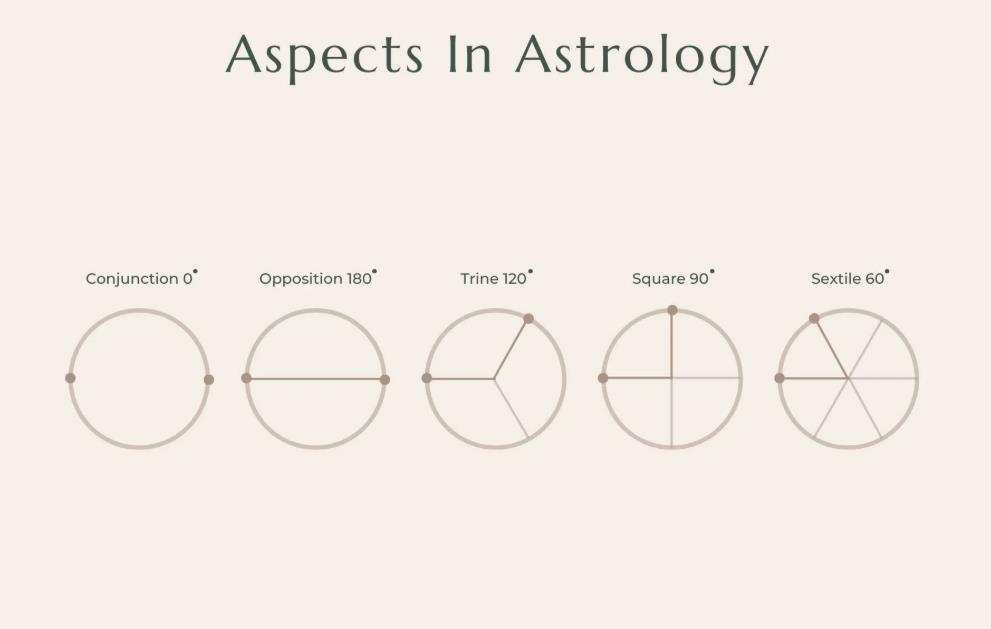
In astrology, an aspect is the angular distance between two planets, points, or chart factors measured in degrees of the 360° zodiac circle. Because planets are always in motion, they continuously form and dissolve aspects with each other. The nature of the angle—whether harmonious, challenging, or neutral—affects how the energies combine.
Aspects are fundamental because:
- They show how different parts of the psyche interact.
- They reveal internal contradictions or synergies.
- They highlight areas of special focus or emphasis.
- They can indicate timing when used in predictive astrology.
A single sign placement cannot tell the whole story of a planet. For example, a Venus in Libra behaves differently if it forms a tight square with Saturn compared to an easy trine with Jupiter. Thus, aspects enrich the narrative of a chart by showing how each planet expresses its potential.
Understanding Orbs
An orb is the number of degrees within which an aspect is considered active. Because planets rarely form angles at exact degrees, astrologers use orbs to determine how close to exact an aspect needs to be for it to count.
Typical orb ranges:
- Conjunction: up to 10° (strongest aspect)
- Opposition: 8°–10°
- Square: 6°–8°
- Trine: 6°–8°
- Sextile: 4°–6°
- Minor aspects: often 1°–3°
Different schools of astrology apply orbs differently. Some traditional astrologers use fixed orbs associated with the nature of the aspect, while modern psychological astrologers may vary orbs based on planetary strength or involvement with the luminaries (Sun and Moon). The tighter the orb, the stronger the expression of the aspect.
Applying vs. Separating Aspects
Astrologers sometimes differentiate between:
- Applying aspects: a faster planet is moving toward exact aspect with a slower one. These are often interpreted as stronger, active, or still-developing influences.
- Separating aspects: the planets have already perfected the aspect and are moving away. These may indicate influences that are familiar, integrated, or part of past experiences.
This distinction is especially helpful in predictive or horary astrology but can also add depth to natal chart interpretation.
Major Aspects
The major aspects—conjunction, sextile, square, trine, and opposition—are considered the core building blocks of chart interpretation. Each aspect has its own symbolic nature and energetic tone.
Conjunction (0°): Fusion and Intensification
The conjunction occurs when two planets align at nearly the same degree. This is one of the most powerful aspects because it blends planetary energies into a single, intensified expression. Depending on the planets involved, the conjunction can be highly harmonious or challenging.
Characteristics of a Conjunction
- Energy is merged and amplified.
- Planetary qualities reinforce or modify each other.
- The conjunction may overshadow nearby influences.
- It acts like a focal point in the natal chart.
Examples
- Sun conjunct Mercury: Analytical thought, strong communication, rational expression, intellectual identity.
- Venus conjunct Mars: Passionate desires, creativity, strong romantic drive.
- Saturn conjunct Moon: Emotional restraint, need for security, serious disposition.
Conjunctions involving malefic planets (such as Mars or Saturn in traditional astrology) can be restrictive or challenging, but they also offer discipline, ambition, and strength. Conjunctions involving benefics (Jupiter and Venus) are typically fortunate.
Sextile (60°): Opportunity and Light Harmony
The sextile is a harmonious aspect that promotes creativity, curiosity, and cooperation. However, unlike the trine, the sextile usually requires conscious effort to activate its potential.
Characteristics of a Sextile
- Represents opportunities rather than guaranteed ease.
- Encourages learning, collaboration, and constructive action.
- Works best when the individual chooses to engage with it.
Examples
- Mercury sextile Mars: Quick thinking, persuasive communication, mental assertiveness.
- Venus sextile Uranus: Innovative creativity, refreshing social interactions.
Sextiles are subtle but rewarding; they often show natural inclinations that can be strengthened with practice.
Square (90°): Tension, Friction, and Growth
The square is one of the most challenging aspects, but also one of the most productive. Squares create tension that demands action, adjustment, and resilience. Without squares, a chart may lack motivation or dynamic expression.
Characteristics of a Square
- Represents friction and conflict between planetary energies.
- Indicates internal pressures or external obstacles.
- Promotes growth through problem-solving and perseverance.
Examples
- Mars square Saturn: Conflicts between drive and discipline; frustration but potential for disciplined strength.
- Sun square Moon: Inner conflict between conscious goals and emotional needs.
Squares often mark areas of life that require continual effort, but they also build character and accomplishment.
Trine (120°): Talent, Flow, and Natural Harmony
The trine is one of the most easygoing aspects. It brings smooth energy flow and natural talent. Because trines are so effortless, they can also become underutilized if the individual does not apply themselves.
Characteristics of a Trine
- Represents natural skill, intuition, and harmony.
- Planetary energies support each other effortlessly.
- Can create situations that feel “meant to be.”
Examples
- Jupiter trine Sun: Optimism, confidence, good fortune.
- Venus trine Neptune: Artistic inspiration, compassion, romantic idealism.
Trines often point to gifts that come easily and support a person’s overall sense of well-being.
Opposition (180°): Balance, Polarity, and Relationship Dynamics
The opposition is formed when two planets stand directly across from each other. It symbolizes polarity, tension, and the need for balance. Unlike the square, its energy manifests more in interpersonal themes or through projection.
Characteristics of an Opposition
- Represents duality and complementary forces.
- Creates tension that seeks harmony.
- Often plays out in relationships and external events.
Examples
- Moon opposite Pluto: Intense emotions, power dynamics, transformative relationships.
- Mercury opposite Jupiter: Balancing details vs big-picture thinking.
Oppositions invite self-awareness; they challenge individuals to integrate two opposing parts of themselves.
Minor Aspects
While the major aspects carry the most weight, the minor aspects add refinement. They may not dominate the chart, but they provide insight into subtler psychological patterns.
Semi-Sextile (30°)
- Slight tension or discomfort.
- Promotes low-level adjustment and awareness.
Quincunx / Inconjunct (150°)
- Signals incompatibility between energies.
- Requires adaptation and often leads to personal growth through continual adjustment.
Semi-Square (45°) & Sesquiquadrate (135°)
- Mildly challenging aspects.
- Can create irritation or restlessness requiring correction.
Quintile (72°) & Bi-Quintile (144°)
- Creative, artistic, or intellectual genius.
- Associated with talent, innovation, and specialized skills.
Minor aspects are particularly useful in psychological astrology, where nuance and subtle patterns are essential.
Aspect Patterns: The Geometry of a Chart
When multiple aspects connect three or more planets, they may form aspect patterns. These patterns fundamentally shape the personality and point to core themes.
Grand Trine
- Three planets forming three trines.
- Indicates natural ability, flow, and blessings.
- May also create passivity or complacency.
T-Square
- One opposition with two squares to a third planet.
- Highly dynamic and motivating.
- Represents challenges that drive success.
Grand Cross
- Four squares and two oppositions.
- High tension, constant challenge, but immense strength.
Yod (Finger of God)
- Two quincunxes connecting to a sextile.
- Suggests karmic or fated themes.
- Points to a sense of unique purpose or life mission.
Kite
- A Grand Trine with an opposition cutting through.
- Provides both ease and motivation; talents activated by tension.
Aspect patterns add structural integrity to the chart, showing how multiple themes interconnect.
Planetary Combinations: How Aspects Transform Meaning
The meaning of any aspect depends heavily on the planets involved. Planetary pairs produce highly specific dynamics.
Personal Planets
- Sun, Moon, Mercury, Venus, Mars
- Influence personality, emotion, communication, and desires.
Social Planets
- Jupiter, Saturn
- Shape growth, restriction, societal roles, and long-term cycles.
Outer Planets
- Uranus, Neptune, Pluto
- Represent collective energies, transformation, and generational themes.
Examples of Notable Combinations
Sun–Pluto (any aspect)
- Transformational identity.
- Power struggles or intense self-development.
Moon–Neptune
- Emotional sensitivity, psychic openness, imagination.
Venus–Saturn
- Seriousness in relationships; loyalty but emotional caution.
Mars–Uranus
- Unpredictable energy, originality, rebellion, sudden actions.
Understanding how each combination expresses in conjunction vs square vs trine brings depth to interpretation.
How Astrologers Interpret Aspects in Practice
Professional astrologers synthesize aspects in several steps:
1. Evaluate the Orb
Closer aspects carry more weight in interpretation.
2. Consider Planetary Strength
Planets in the angular houses (1st, 4th, 7th, 10th) or dignified by sign may express aspects more forcefully.
3. Integrate House Positions
A square between the Moon in the 4th house and the Sun in the 10th house will focus on private vs public life conflict.
4. Check Sign Expression
A trine between planets in Earth signs behaves differently from one in Fire signs.
5. Examine Patterns
Multiple squares pointing to a single planet highlight that planet’s central importance.
6. Look for Repetition
Repeating themes across aspects, houses, and signs are most significant.
Together, these steps allow astrologers to build cohesive interpretations.
Aspects in Predictive Astrology
While this article focuses on natal charts, aspects also play a vital role in forecasting:
Transits
Current planetary movements form aspects to natal planets, triggering events or psychological shifts.
Progressions
Symbolic movement of planetary positions over time, adding layers of internal development.
Solar Returns
Annual charts for birthday-to-birthday cycles where aspects show themes for the year.
Challenging transits often activate natal squares or oppositions, while harmonious transits amplify trines and sextiles.
Psychological and Evolutionary Perspectives on Aspects
Modern astrology often adopts psychological frameworks. Aspects represent internal dialogues between different parts of the psyche.
Harmonious Aspects
- Indicate aspects of the self that “get along.”
- Easy access to talents and instincts.
Challenging Aspects
- Reveal unresolved conflict or tension.
- Stimulate growth, maturity, and awareness.
In evolutionary astrology, aspects may indicate karmic lessons or areas of soul development. Squares and oppositions can represent unresolved patterns from past incarnations or deep generational wounds. Trines may indicate past life mastery in certain areas.
Why Aspects Matter More Than You Think
Many beginners focus primarily on zodiac signs, but aspects give astrology its depth and accuracy. They explain:
- Why two people with similar charts can behave very differently
- Why someone with a “difficult” Sun sign still has harmonious personal qualities
- Why individuals with challenging placements still show resilience, talent, or brilliance
Aspects are the connective tissue of a chart—they reveal how a person’s inner world operates, where tension or ease exists, and how their life stories unfold.

Aspects are among the most powerful interpretive tools in astrology. They describe how the energies of the planets combine, conflict, harmonize, or challenge one another. Understanding aspects offers a deeper understanding of personal strengths, emotional patterns, relationships, creative potential, and life purpose.
Conjunctions bring intensity, sextiles offer opportunity, squares create tension, trines grant natural flow, and oppositions teach balance. Minor aspects refine the picture, while complex patterns reveal the architecture of the chart as a whole.
To truly understand astrology, one must move beyond isolated placements and explore the intricate web of relationships that aspects create. With practice, they bring charts to life and reveal the rich, multidimensional nature of human experience.
Disclaimer: This article is for educational and entertainment purposes only and should not be interpreted as professional advice.

Leave a Reply